7 min readMarkdown
How to make an AI influencer that stays the same person
Invent a character from one line, lock her face in a bible, put her in a video she was never in, then hand her your product. Five steps, one face.
A man with a blond bob shadowboxed through a run of short videos, completely deadpan. Within eight days, more than 228,000 people followed him on Instagram, and the comments were mostly people asking whether he was real. Real? An actor? AI?
That is Jean Phil, and characters like him are an advertising format few brands have tried: they stop the scroll, they get copied, and they get argued about.
Why a weirdo beats a pretty face
The formula is short. A curled moustache, a houndstooth suit, one absurd trait worn with total conviction. The algorithm did the rest: in a few days he was a trend rather than a video, and everyone knew the bob, the suit and the catchphrase, “Oui Madame.”
The obvious next move was to put that recognition on a product. His accounts promoted a memecoin instead, which reportedly collapsed within a day. The coin is a footnote. The character is the asset, and it is the part you can copy.
Most brands meet AI here as the other thing: photoreal faces built to pass as human. A pretty face is the cheapest thing a model makes, which is why nobody remembers one. Nobody texts a friend “you have to see this normal-looking woman.” They text about the librarian.
Like every format that works, this one has a shelf life, and right now the shelf is nearly empty.
Five steps, one character
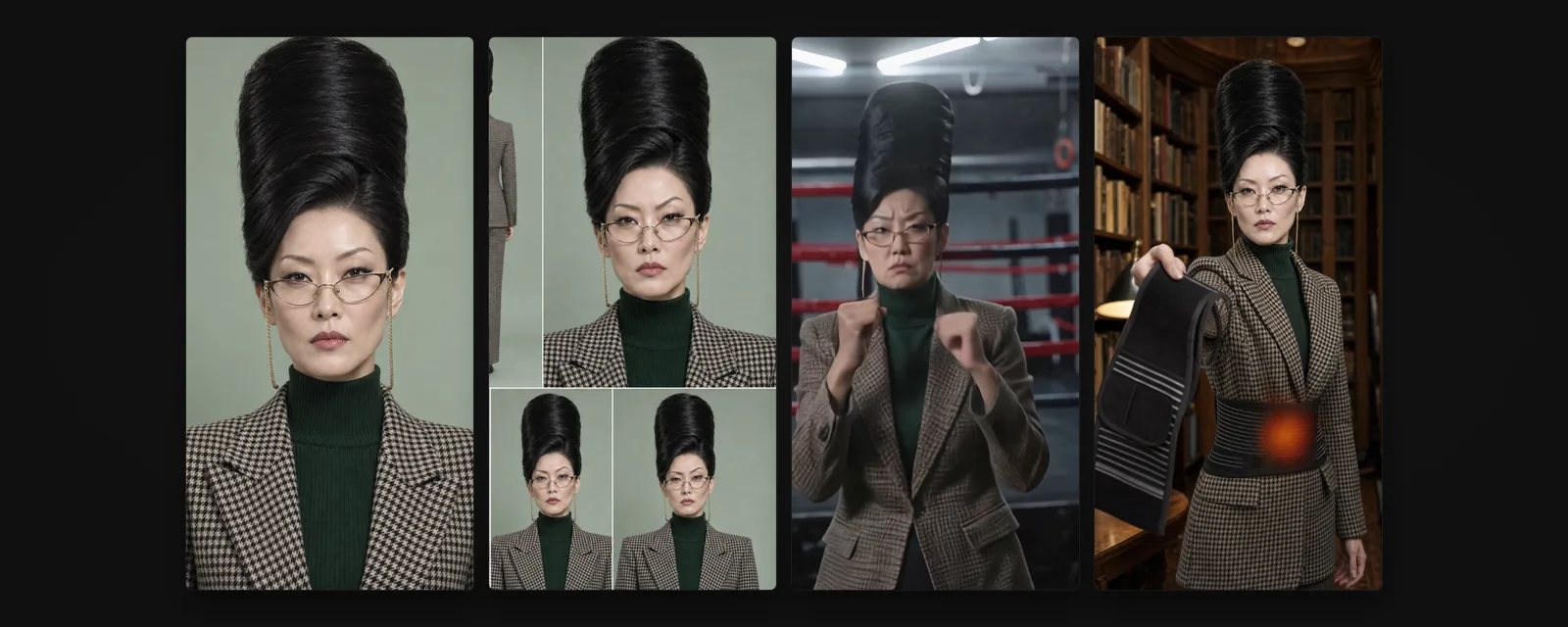
The character below is Ms. Sit-Up. Everything was made in Kuro, each step landed on the first take, and none of it needed a photo of a real person.
Each step is a recipe in the public catalog, linked as it comes up. For what Kuro does for a virtual creator beyond these five steps, from her voice to her posting schedule, see AI influencers.
1. One line
The Invent an Uncanny Character recipe asks for three choices and one sentence. There is no photo slot, so nobody’s face goes in and nobody is deepfaked.
Woman · 40s · Comedy
"A strict Korean librarian who judges everyone's posture"
Out came a towering black beehive, cat-eye glasses on gold chains, a green turtleneck, a houndstooth blazer and a face that had already judged me.

Absurd is the brief, not the bug. The same recipe, given “a deadpan Dubai gentleman who shadowboxes in the most luxurious places of the city”, returned two of them: one in gold aviators, one with a blunt helmet bob.

2. A name
Save her as a Subject, here called Ms. Sit-Up. A Subject is a saved identity: a face, a product, a mascot, anything that keeps coming back. From then on you tag her by name instead of attaching pictures, and her description rides along into every generation.
One detail worth knowing: “Save as character” keeps the face. The description is yours to write, in the Subject editor, and it is where you say what she lacks as well as what she has.
3. A bible
The Influencer Bible recipe does not ask for a backstory. It asks for what must never change.
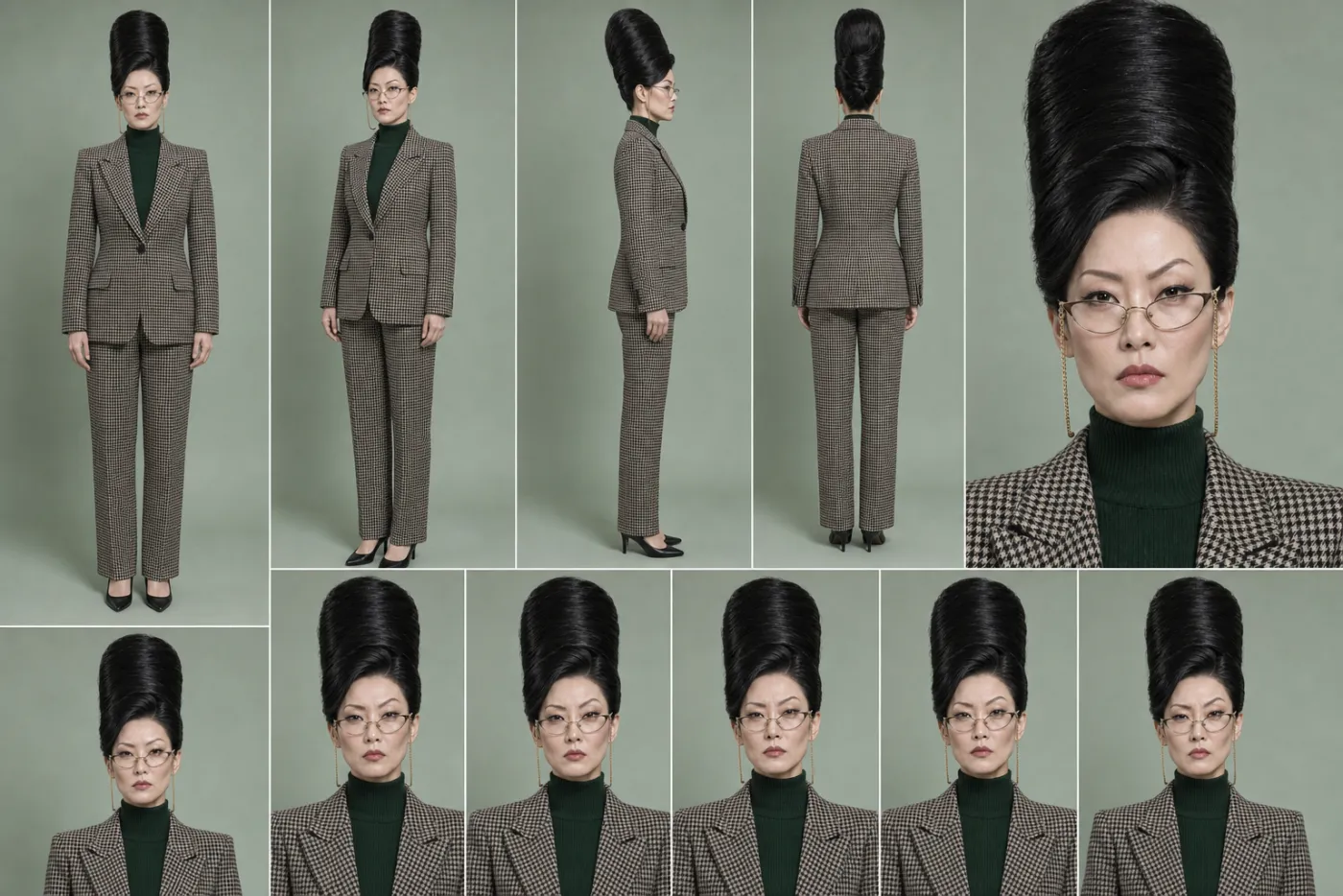
Signature expressions, posture and the signature outfit exactly as in the reference, kept identical in every view. Her one expression is silent disapproval: lips pressed, one eyebrow raised, never a smile. Her posture is ramrod straight in every view, chin level, shoulders back, as if a ruler were taped to her spine. The black beehive is perfectly rigid and the same height from every angle. Cat-eye glasses on thin gold chains, green turtleneck, brown houndstooth blazer, always.
What comes back is her reference sheet: four full-body turnarounds, one large close-up and six head shots. It is why she has the same face, the same beehive and the same raised eyebrow in every later frame, instead of a slightly different stranger each time. She does not smile. It is normal for her.
4. A video she was never in
There are two ways to make a character move. You can invent the scene and let a model generate the camera, the motion and the timing frame by frame. Or you can borrow one: take a video that already exists and change the one thing you own, who is in it. The camera, the timing and the motion are already real.
Borrowing is the stronger default, because a generated performance still produces the occasional jab that bends like spaghetti and a borrowed one already works. It works with any short you have the right to use: one you filmed, one you licensed, or a stock clip.
I used a free stock clip, a woman shadowboxing straight at the lens, seven seconds in one take. It is a nod to Jean Phil that does not touch his footage. Then the Swap Character recipe, with Ms. Sit-Up tagged:
Replace the woman boxing with Ms. Sit-Up. She throws every jab and hook exactly as in the source, ramrod-straight posture, completely deadpan, never smiling. Keep the boxing gym, the ring ropes, the lights and the handheld camera movement unchanged.
I ran it on two models, and the trade-off is worth seeing in one frame:
- Genjutsu gave the livelier take and a face that matches the still, but it swapped the bright gym for a dark arena and kept only the red ropes, against the prompt’s instruction.
- P-Video Replace kept the gym and the punches exactly, but her face drifted into a squint instead of the deadpan.
This was one clean shot with one performer, so it is a single data point, not a ranking. Run both when the face matters and when the set matters, and keep the take that holds the one you care about.
5. A product
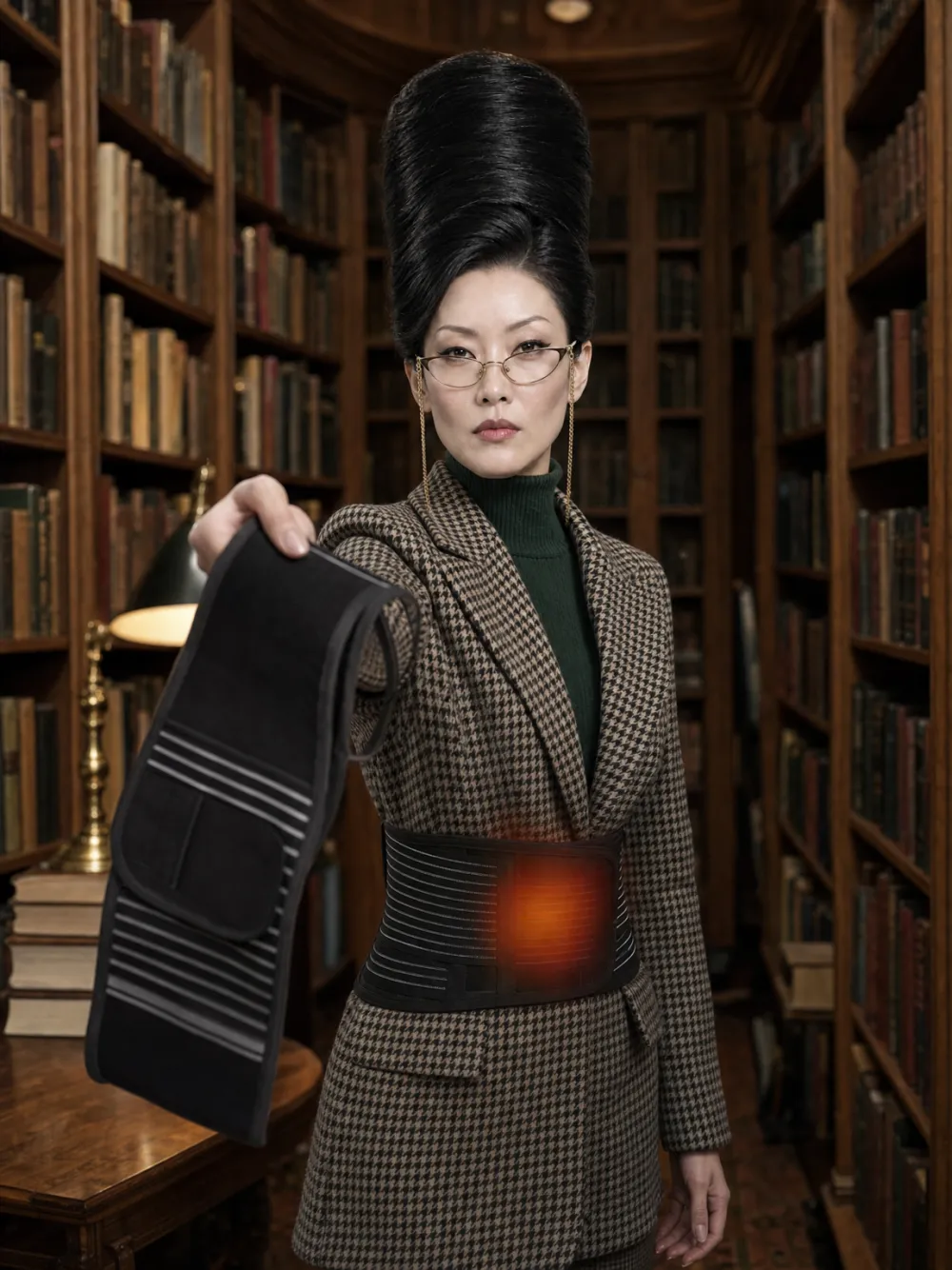
The Sponsored Product Post recipe takes two Subjects: the character and your product. Mine was a heated back belt. She wears one over the houndstooth, orange heat glowing at her lower back, and holds a second one out to you at arm’s length, like something she just confiscated.
Why this works
Brands do not have a face problem. They have a memory problem. The weird one is the one people describe to a friend.
Doubt earns comments. An AI face wants you to believe it. A weirdo wants you to wonder. Everyone who cannot tell says so, in the comments, where the algorithm is listening.
One trait, one benefit. The casting is the pitch: a librarian who judges your posture, selling a back belt. There is no script. The joke is the sales copy.
Borrow the performance. Keep the part that is hard to make and change the part you own.
She never breaks character. A human creator has off days, other sponsors and opinions at 2 a.m. Ms. Sit-Up has a bible: same face, same beehive, same eyebrow, every time.
What you need to do
- Write one line. Make it rude.
- Save the character and give it a name.
- Write the bible: the things that must never change.
- Bring a short video you have the rights to, and tag your character into it.
- Tag your product next to them.
If the brand wants a photoreal creator rather than a character, start from Create an AI Influencer instead of step 1. Steps 2 to 5 do not change: a Subject, a bible, a borrowed video, a product.
One line, one video, one deeply judgmental new hire. Every step also runs from
Claude through the Kuro connector, where you can tag her with @Ms. Sit-Up and
never upload her again.
Kuro is my product, so weigh this accordingly. If you already pay Replicate, fal or Higgsfield, you can plug those keys into a free account and every recipe runs on them, billed by the provider directly.
Why now
Most brands still read “AI influencer” as a pretty face pretending to be human. Jean Phil showed the other way, then pointed it at a memecoin. Point yours at a product, before the brand next door does.
Everything here runs in the studio.
Every model named on this page is one you can pick from the composer.
Where next: Ready-made recipes · What a credit buys
Sign up now